
The short answer: a hernia does not heal on its own, but not every hernia needs an operation this week. This guide is for the decision before surgery — how to tell a hernia from a muscle pull, when waiting is reasonable and when it is not, what "mesh" actually is, what recovery looks like week by week, and the questions worth asking any surgeon. For the types of hernia and how the operation is done, see our hernia surgery service page.
Many people first notice a hernia after lifting something heavy and assume they have "pulled a muscle". The two feel different.
A simple self-check: lie down, let the area relax, then stand and cough with your hand resting over it. A swelling that pops out and goes back is worth showing to a surgeon. The examination takes a few minutes; if it is unclear, an ultrasound usually answers the question.
This is the question patients most want an honest answer to. Sometimes, yes. International hernia guidelines accept watchful waiting for some adults with a small groin hernia that causes little or no discomfort, once a surgeon has examined it. Waiting in this sense is a decision, not neglect: you know the hernia is there, you know the warning signs, and you are reviewed if it changes.
Waiting is usually not the right choice when:
Be realistic, too: a hernia does not heal by itself, and planned surgery at a time that suits you is easier than an emergency operation. That is why Dr Bansal advises planned repair for most patients, and watchful waiting only for selected ones.
Go to a hospital emergency the same day if a hernia:
These can mean that a loop of bowel is trapped and its blood supply is at risk. Do not try to push it back forcefully, and do not wait for a clinic appointment.
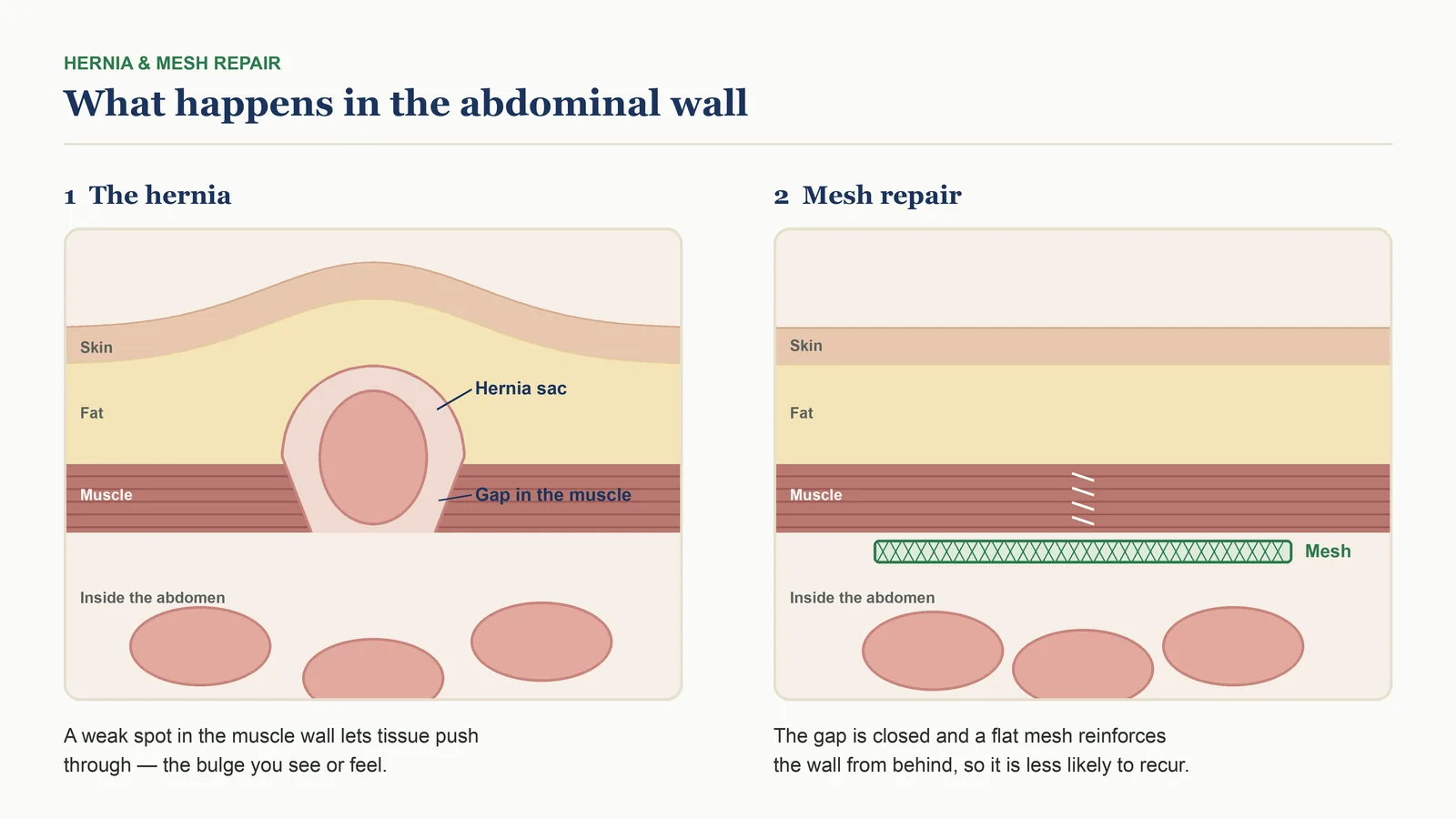
"Mesh" makes many patients uneasy because it sounds like a foreign object left inside the body. In practice it is a thin, flexible, sterile sheet of surgical material with an open weave, a little like fine netting. It is placed over or behind the weak spot in the muscle wall, as in the diagram above.
Over the following weeks the body's own tissue grows into and through the weave. The mesh does not hold the hernia in by itself for ever — it acts as a scaffold that reinforces the wall with your own scar tissue, spreading the strain over a wide area rather than relying on a single line of stitches.
That is the reason for the plain recommendation: mesh repair is the standard, and is recommended for the great majority of adult hernias, because stitch-only repair has a far higher chance of the hernia coming back. The mesh is placed in the same position whether the operation is laparoscopic (through small keyhole cuts) or open (through one cut over the hernia); the route changes, the principle does not.
Non-mesh (stitch-only) repair is possible, but it is the exception rather than an alternative that suits everyone. The usual situations are:
If you have been told a no-mesh repair is "better" or "more natural", ask which of these reasons applies to you. If none does, the trade-off is a higher chance of needing a second operation later.
This is the general pattern after a planned, uncomplicated repair; your surgeon will adjust it for you.
Call your surgeon if you develop fever, spreading redness or discharge from the wound, pain that is getting worse rather than better, or difficulty passing urine.
With Dr A K Bansal, hernia surgery in Lucknow typically costs ₹40,000 – ₹1,50,000. Where a case falls in that range depends on four things:
As with other planned operations, ask for a line-itemised estimate rather than a single package figure, and check what is billed separately. Our guide to gallbladder surgery costs in Lucknow explains how hospital packages, insurance and hidden charges work; the same questions apply to hernia repair.
Whoever you consult, these questions will tell you a great deal about the plan — and about the surgeon:
At Dr Bansal Gastro & Liver Centre, hernia repair is performed by Dr A K Bansal — M.Ch Surgical Gastroenterology, SGPGI Lucknow (All India Rank 1), Ex Senior Consultant Medanta, Head of GI Surgery at Myra City Hospital, with 15+ years of experience and 5000+ surgeries. The clinic is at 6C/973, Sector 6, Gomti Nagar Extension, Lucknow (Mon–Sat, 10 AM–1 PM and 5 PM–8 PM); Myra City Hospital 1:30–5:30 PM. Out-of-town patients can read our note for patients from Faizabad and Ayodhya, or send reports on WhatsApp at +91 98899 98885 before making the journey.
A hernia usually has a soft bulge that appears when you stand, cough or strain and goes back when you lie down. A muscle pull follows a specific effort, is tender, has no bulge and settles over days to weeks. An examination, sometimes with an ultrasound, settles it.
For some adults with a small groin hernia causing few symptoms, watchful waiting after examination is a recognised option. Painful, enlarging, stuck and femoral hernias are usually repaired. A hard, tender hernia that will not go back, especially with vomiting, is an emergency.
For the great majority of adult hernias, yes — mesh is the standard because stitch-only repair has a far higher chance of recurrence. Non-mesh repair is reserved for exceptions such as very small defects, some young patients or an infected field.
Walking the same day; desk work about a week after laparoscopic repair and one to two weeks after open repair; no heavy lifting for 4–6 weeks.
Typically ₹40,000 – ₹1,50,000 with Dr A K Bansal, depending on the hospital setup, laparoscopic or open repair, one side or both, and the size of the hernia.
Get it examined. Dr Bansal will tell you what type of hernia it is, whether waiting is reasonable, and — if repair is advised — the plan and the cost before you decide.
Book Consultation